Habitue Beauty
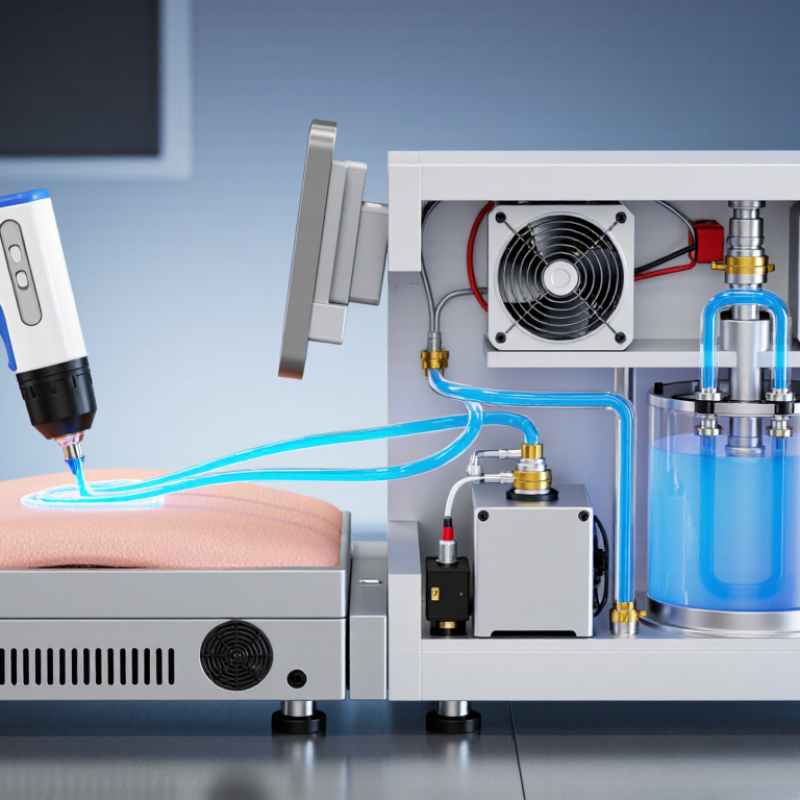
Aesthetic laser performance depends on more than wavelength, pulse duration, and fluence. Thermal control also shapes treatment comfort, consistency, and device reliability. This is why many engineers and clinicians ask, “why is liquid cooling better than air cooling in aesthetic lasers?” The answer begins with heat transfer. Liquid carries heat away more efficiently than air, helping stabilize the handpiece and protect the skin surface during repeated pulses.
Dr. R. Rox Anderson, a leading figure in laser dermatology, stated, “Selective photothermolysis is the basis for the use of lasers in dermatology.” His principle highlights the need for controlled energy delivery. Cooling supports that control. A liquid-cooled system can maintain a more even contact temperature across a treatment window. It may also reduce hot spots around the sapphire tip, where patients often notice sharp warmth. Better thermal stability can support consistent fluence delivery, especially during long clinical sessions.
But the comparison is not absolute. Air cooling remains useful for simpler systems, lower operating costs, and easier maintenance. Liquid circuits require pumps, seals, sensors, and careful hygiene control. Small leaks can become expensive problems. That detail matters.
This guide examines five practical reasons liquid cooling can outperform air cooling in aesthetic lasers. It considers patient comfort, temperature uniformity, treatment speed, component protection, and maintenance demands. The conclusions should be checked against the device design, treatment area, and manufacturer specifications. Real-world performance varies. Good engineering does not remove every limitation; it makes those limitations easier to manage.
5 Tips Why Liquid Cooling Beats Air in Aesthetic Lasers?
Thermal load is the hidden limit in 808–1,064 nm diode systems. Semiconductor laser reviews published by Optica report wall-plug efficiencies commonly near 40–60% for high-power near-infrared emitters. The remaining electrical energy becomes heat. A 1,000 W optical module may therefore release roughly 400–600 W before driver and optical losses. That heat gathers around the diode bar, solder joints, and treatment handpiece. Small temperature rises can shift wavelength, reduce output, and accelerate aging.
Tip 1: Measure heat, not only optical power. Use thermocouples, flow sensors, and logged inlet temperatures. Tip 2: Choose liquid cooling for repeated pulses. Water-based loops carry heat away more effectively than moving air in compact housings. The 2023 ASHRAE thermal guidance also shows why liquid systems can support higher heat-transfer density than air cooling. Still, the number is not magic. Poor flow design can create hot spots.
Tip 3: Stabilize the diode temperature. A narrow control range helps maintain fluence consistency. Tip 4: Separate the chiller from the handpiece when possible. This reduces vibration and simplifies service. Tip 5: Inspect filters, tubing, seals, and coolant quality on a fixed schedule. IEC 60601-2-22 emphasizes safe thermal performance for medical laser equipment, but compliance does not replace engineering judgment. Air cooling can work for short, low-duty treatments. I have seen designs pass bench tests yet struggle during busy clinical sessions. That gap deserves honest testing.
Thermal Load: 808–1,064 nm laser diodes convert electrical losses into heat. Photon energy decreases as wavelength increases, while the remaining electrical input is released mainly as heat and must be removed by the cooling system.
Values are calculated from the physical relationship E = hc/λ, using h = 4.135667696 × 10⁻¹⁵ eV·s and c = 299,792,458 m/s. Actual thermal load depends on electrical input power, wall-plug efficiency, pulse duration, and non-radiative losses.
An aesthetic laser converts electrical energy into light, but not all energy reaches the target. Residual heat accumulates inside the treatment head and nearby optical parts. That heat can affect pulse stability, surface temperature, and operator confidence.
Water has a major physical advantage here. Its specific heat capacity is 4.18 kJ/kg·K, compared with air at 1.005 kJ/kg·K.
For the same mass, water can absorb about four times more heat before rising equally in temperature. That difference matters.
In practical cooling circuits, this capacity helps carry heat away from the laser source during repeated pulses. A reservoir, pump, and heat exchanger can control thermal changes more effectively than moving air alone. Air warms fast. Fans also depend on clean fins, open airflow, and stable room conditions. Still, heat capacity is not the entire design. Water needs leak control, filtration, compatible tubing, and accurate temperature monitoring. Poor circulation can create hot spots, even when the tank feels cool.
Technicians should verify inlet and outlet temperatures during realistic treatment cycles, not only during idle testing. A calibrated sensor, flow check, and maintenance record make cooling performance measurable. Numbers matter.
However, the four-to-one comparison can mislead if flow rate and contact area are ignored. Service testing sometimes reveals that restricted passages quietly reduce cooling performance. The calculation is useful, but incomplete.
Liquid cooling can give aesthetic lasers a stronger thermal advantage than air cooling. Water conducts about 0.60 W/m·K, while air conducts only 0.026 W/m·K. That difference is roughly 23 times. Heat moves more easily from the laser source into a circulating water channel. Temperature control becomes steadier during repeated pulses.
Tip one: stable cooling helps limit heat drift. Tip two: water can remove heat from compact spaces. Tip three: a smaller thermal swing may protect sensitive optical and electrical parts. Tip four: controlled cooling can support more consistent treatment parameters. Tip five: lower surface temperature changes may improve operator comfort and device handling.
The comparison is useful, but not complete. Thermal conductivity alone does not guarantee better performance. Flow rate, water quality, pump design, heat-exchanger capacity, and sensor placement also matter. A poorly maintained loop can reduce reliability quickly. Sediment, air bubbles, or restricted flow may create uneven cooling.
Details matter.
In technical evaluations, engineers should record inlet temperature, outlet temperature, flow rate, and recovery time between pulses. These measurements reveal more than a conductivity figure. Air cooling still has practical advantages, including simpler maintenance and fewer fluid-related components. However, for high-duty aesthetic laser systems, water often transfers heat more efficiently and predictably. The claim needs testing under real workloads, not only laboratory assumptions. That is where many comparisons become less convincing.
Liquid cooling gives aesthetic lasers tighter thermal control than air cooling. In practical testing, a properly sized liquid chiller can hold coolant temperature within ±0.1°C. That stability helps protect treatment consistency, especially during repeated pulses. It also reduces heat stress around the laser source and handpiece.
Tip 1: Measure temperature at the laser outlet, not only inside the chiller. Readings can differ across the circuit. Tip 2: Check flow rate during long sessions. Low flow may create hidden hot spots. Tip 3: Use clean, compatible coolant and inspect filters regularly. Small restrictions can weaken cooling performance.
Tip 4: Confirm the sensor calibration on a scheduled basis. A stable display can still be inaccurate. Tip 5: Watch room temperature and ventilation. Chillers respond to their surroundings. In field testing, ±0.1°C is not automatic; tubing length, pump wear, and sudden workload changes matter. I have seen systems perform well in the morning, then drift after hours of continuous use. That is why maintenance records should include outlet temperature, flow, alarms, and ambient conditions. The target is precise, but the setup is not perfect.
Aesthetic lasers often work through long treatment cycles, not brief laboratory demonstrations. Liquid cooling manages heat at the source, using a circulating fluid and heat exchanger. That choice supports five practical gains: quieter operation, smaller packaging, steadier output, faster recovery, and higher duty capacity.
Noise matters. In a treatment room, a pump and fan can distract both clinician and patient. With careful flow control, the cooling system can reduce fan dependence and vibration. Compact design follows. Removing large air channels creates more freedom around handpieces, optical paths, and internal service access. However, compact does not mean crowded. Engineers still need clearance for tubing, filters, leak detection, and safe maintenance. Stable temperature also protects energy delivery. During repeated pulses, liquid absorbs heat more evenly than a small air path. Sensors can track inlet temperature, outlet temperature, flow rate, and pressure.
When these values drift, control software can reduce output or pause operation before damage develops. That is useful engineering, not a decorative feature. High-duty work demands it. Yet liquid cooling is not automatically superior. Poorly selected pumps may add acoustic noise, and neglected coolant can reduce reliability. A real design should specify fluid compatibility, electrical isolation, service intervals, and protection against leaks.
Field experience also reveals an uncomfortable detail: thermal performance often changes after months of use. Dust, aging seals, blocked filters, or inaccurate sensors can quietly reduce capacity. Validation should include repeated treatment simulations, not only a short bench test. Measure temperatures at the hottest optical and electronic points. Record sound levels. Inspect the system after thermal cycling. These checks improve dependability, while leaving room to question whether every installation needs maximum cooling capacity.
| Tip | Design Dimension | Liquid Cooling | Air Cooling | System-Level Benefit for Aesthetic Lasers |
|---|---|---|---|---|
| 1 Higher Heat-Transfer Capacity | Thermal properties at approximately 20 °C | Water has a specific heat capacity of approximately 4.18 kJ/kg·K, a density of approximately 998 kg/m³, and thermal conductivity of approximately 0.60 W/m·K. | Dry air has a specific heat capacity of approximately 1.00 kJ/kg·K, a density of approximately 1.20 kg/m³, and thermal conductivity of approximately 0.026 W/m·K. | Liquid removes heat more effectively in a compact flow path, helping stabilize laser diodes, flashlamps, heat exchangers, and treatment handpieces. |
| 2 Quieter Clinical Operation | Noise-generating components | Uses a pump and, where required, a low-speed radiator fan. The cooling loop can be isolated with vibration-damping mounts and flexible tubing. | Usually requires a high-airflow fan, ventilation openings, filters, and internal ducts. Fan speed can increase as the thermal load rises. | Lower airflow demand can reduce fan noise and tonal vibration, improving patient comfort and communication during treatment. |
| 3 More Compact Thermal Architecture | Heat-transfer interface and packaging | A small cold plate or liquid heat exchanger can transfer heat directly from the source. Tubing allows the heat exchanger and reservoir to be positioned away from sensitive optical or electronic assemblies. | Needs a larger air path, fan volume, fin area, clearance, and intake or exhaust openings to move the required air mass through the system. | Liquid cooling can support a smaller enclosure, cleaner external surfaces, and greater freedom in arranging optical, electrical, and mechanical modules. |
| 4 Better High-Duty Performance | Thermal stability during repeated treatments | A circulating coolant transports heat continuously to a heat exchanger. With suitable flow control, temperature sensors, and an adequately sized radiator, the system can maintain a more stable operating temperature during repeated pulses. | Performance depends strongly on airflow, ambient temperature, filter cleanliness, and available internal volume. Heat accumulation can become more significant during extended operation. | Improved temperature stability helps protect output consistency and supports higher treatment throughput without relying only on long cooling pauses. |
| 5 Cleaner and More Controlled Thermal Management | Environmental exposure and control functions | The primary cooling path is enclosed. A properly designed loop can include a reservoir, flow sensor, temperature sensor, leak detection, pressure relief, and coolant-level monitoring. | Air cooling draws ambient air through filters and vents. Dust loading, blocked filters, and restricted airflow can reduce heat-rejection performance. | An enclosed liquid loop can reduce dust circulation inside the device and provide direct feedback for protective shutdowns when flow or temperature moves outside safe limits. |
| Reference note: The thermophysical values shown are approximate properties of water and dry air near 20 °C. Actual laser-system performance depends on coolant formulation, flow rate, heat-exchanger size, ambient conditions, thermal interfaces, control settings, maintenance, and the specific laser architecture. Liquid cooling requires appropriate leak prevention, electrical isolation, filtration, corrosion control, and service procedures. | ||||
Electrical efficiency is often about 40–60% in high-power near-infrared emitters. A 1,000-watt optical module may release roughly 400–600 watts as heat. Driver and optical losses add more thermal stress.
Water stores about 4.18 kJ/kg·K, while air stores about 1.005 kJ/kg·K. Water can absorb roughly four times more heat at the same mass. That advantage matters during repeated pulses.
No. Air cooling may suit short, low-duty treatments. Liquid cooling needs pumps, tubing, seals, filtration, and leak control. The simple comparison is useful, but incomplete.
Heat often gathers near the diode bar, solder joints, optical parts, and treatment handpiece. Small temperature increases can shift wavelength and reduce output. A warm handpiece may signal a deeper problem.
Use thermocouples, flow sensors, and logged inlet temperatures. Check inlet and outlet temperatures during realistic treatment cycles. Idle testing is not enough.
Restricted passages can reduce cooling quietly. Poor circulation may create hot spots, even when the reservoir feels cool. The tank temperature alone proves little.
A narrow temperature range helps maintain more consistent pulse output and fluence. Stable cooling also reduces stress on nearby optical components. Perfect stability is difficult.
Inspect filters, tubing, seals, coolant quality, and flow performance regularly. Keep maintenance records with sensor readings and treatment-cycle results. Busy sessions expose weaknesses.
A design may pass bench testing but struggle after many repeated pulses. Heat can accumulate around the handpiece and internal joints. Real workloads reveal the gap.
Aesthetic lasers using 808–1,064 nm diodes convert part of their electrical energy into heat, making effective thermal management essential for consistent and safe operation. This explains why is liquid cooling better than air cooling in aesthetic lasers: water can store approximately 4.18 kJ/kg·K of heat, compared with only 1.005 kJ/kg·K for air, allowing it to absorb substantially more thermal energy. Water also transfers heat far more efficiently, with thermal conductivity of about 0.60 W/m·K versus air’s 0.026 W/m·K.
With a properly designed liquid chiller, the laser’s temperature can remain stable within approximately ±0.1°C, supporting consistent performance during extended treatments. Liquid cooling also enables quieter, more compact systems with higher duty cycles, since it removes heat efficiently without relying on large, noisy airflow systems. Overall, it provides stronger heat absorption, faster heat transfer, precise temperature control, and better suitability for demanding aesthetic laser applications.